
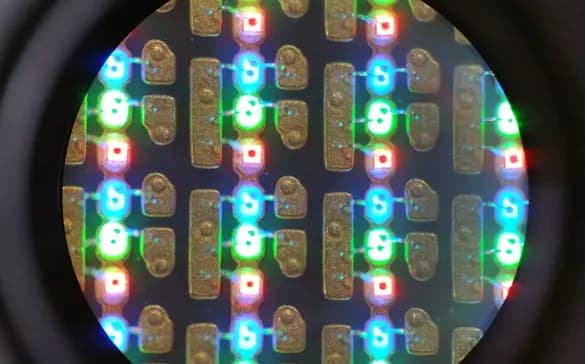
Flip-Chip vs Wire-Bond LED: Which Is Better for LED Displays?
A practical guide to wire-bond and flip-chip LED packaging, covering reliability, brightness, thermal performance, pixel pitch, repair decisions, and where each technology fits in LED display applications.
LED Packaging Guide
Flip-Chip vs Wire-Bond LED Packaging: Which Is Better for Fine-Pitch LED Displays?
When people compare LED lamp beads, they often look at brightness, color temperature, viewing angle, or color consistency. But for LED display engineers, one of the most important questions is more fundamental: is the LED package wire-bonded, or is it flip-chip?
The package structure affects reliability, heat dissipation, optical efficiency, pixel density, module repair strategy, and long-term screen stability.
Quick Answer
Wire-bond LEDs are mature and cost-effective. Flip-chip LEDs are stronger for high-brightness, high-density, and high-reliability display applications.
Best Fit
Flip-chip packaging is especially useful for Mini LED, Micro LED, COB modules, GOB modules, automotive lighting, and fine-pitch LED screens.
Repair Note
Before replacing LEDs on a module, confirm the package type, brightness bin, optical angle, color bin, and soldering process.
1. What Is a Traditional Wire-Bond LED?
In a traditional face-up LED package, the P electrode and N electrode are usually located on the top side of the chip. Thin gold wires connect the chip electrodes to the substrate or lead frame. Light also exits from the top side of the chip.
This structure is widely used because the process is mature, the cost is relatively low, and the supply chain is easy to access. It is still common in general lighting, standard indicator LEDs, and many cost-sensitive display products.
Main limitations of wire-bond LED packaging
- Gold wires are a potential failure point. Vibration, thermal cycling, weak bonding, or mechanical stress can lead to wire breakage or unstable contact.
- Some light is blocked. Top-side electrodes and bonding wires can absorb or shade part of the emitted light.
- The heat path is longer. Heat often needs to pass through the chip base, adhesive, and carrier before reaching the PCB or heat sink.
- Fine-pitch layout is limited. Wire loops need physical space, making ultra-dense LED placement more difficult.
2. What Is a Flip-Chip LED?
In a flip-chip LED, the chip is turned over so the electrodes face downward. Instead of gold wire bonding, the chip is directly connected to the substrate through solder bumps, eutectic bonding, or reflow soldering. Light exits from the opposite side.
In simple terms, flip-chip packaging removes the wire-bonding step and creates a more direct electrical and thermal connection between the chip and the substrate.
3. Why Flip-Chip LEDs Are Used in Higher-End Display Products
Higher reliability
Removing the gold wire eliminates wire breakage, weak bonding, vibration cracking, and many thermal fatigue risks.
Better light extraction
With no wire loop on the emitting surface, more of the chip area can contribute to useful light output.
Improved heat dissipation
Heat can move through the electrode and solder joint into the substrate more directly, reducing junction temperature.
Fine-pitch ready
Without wire-loop clearance, chips can be arranged more densely for Mini LED, Micro LED, COB, and GOB designs.
4. Wire-Bond vs Flip-Chip: Practical Comparison
| Item | Wire-Bond LED | Flip-Chip LED |
|---|---|---|
| Electrode position | Top side / light-emitting side | Bottom side / substrate side |
| Electrical connection | Gold wire bonding | Direct soldering, eutectic bonding, or reflow |
| Optical obstruction | Electrodes and wires can block part of the light | Less obstruction on the emitting surface |
| Thermal path | Longer and less direct | Shorter and more efficient |
| Mechanical reliability | Gold wire may fail under stress | No bonding wire, better vibration resistance |
| Fine-pitch capability | Limited by wire-loop spacing | Suitable for high-density chip placement |
| Cost | Lower, mature process | Higher, but decreasing as the process matures |
| Typical applications | General lighting, indicators, standard modules | Mini LED, Micro LED, automotive lighting, high-end LED displays |
5. What This Means for LED Display Repair
For repair technicians, the package type changes how you think about failure analysis and replacement. A wire-bond LED may fail because of broken wires, weak bonding, or thermal stress near the bonding area. A flip-chip LED reduces wire-related failures, but it also requires better soldering control, pad inspection, and thermal management.
When replacing LEDs on a fine-pitch module, do not only match the package size. Also confirm the optical bin, brightness bin, color coordinates, viewing angle, forward voltage, and soldering process. Mixing different structures can create visible color blocks or brightness inconsistency after repair.
6. Which One Should You Choose?
If your project is cost-sensitive and the working environment is not demanding, wire-bond LED packaging can still be a reasonable choice. It is mature, available, and easy to source.
If your LED display needs higher brightness, smaller pixel pitch, stronger vibration resistance, lower thermal stress, longer lifetime, or more compact chip placement, flip-chip LED packaging is usually the better direction.
Simple conclusion: wire-bond LEDs are mature and cost-effective; flip-chip LEDs are better suited for high-performance, high-density, and high-reliability LED display applications.
Final Thoughts
Flip-chip LED technology is not just a small packaging change. It is one of the core technologies behind Mini LED, Micro LED, COB LED modules, GOB LED modules, automotive lighting, and next-generation high-end LED displays.
As bonding equipment, substrate materials, and mass-production processes continue to improve, flip-chip LEDs are expected to move from premium applications into more mainstream LED display products. For buyers, repair engineers, and module suppliers, understanding the difference between wire-bond and flip-chip packaging helps make better decisions in product selection, troubleshooting, and long-term maintenance.